
The 8 AI Shifts That Just Changed Everything
By Tijo Gaucher & Annaki Nguyen · Human+AI
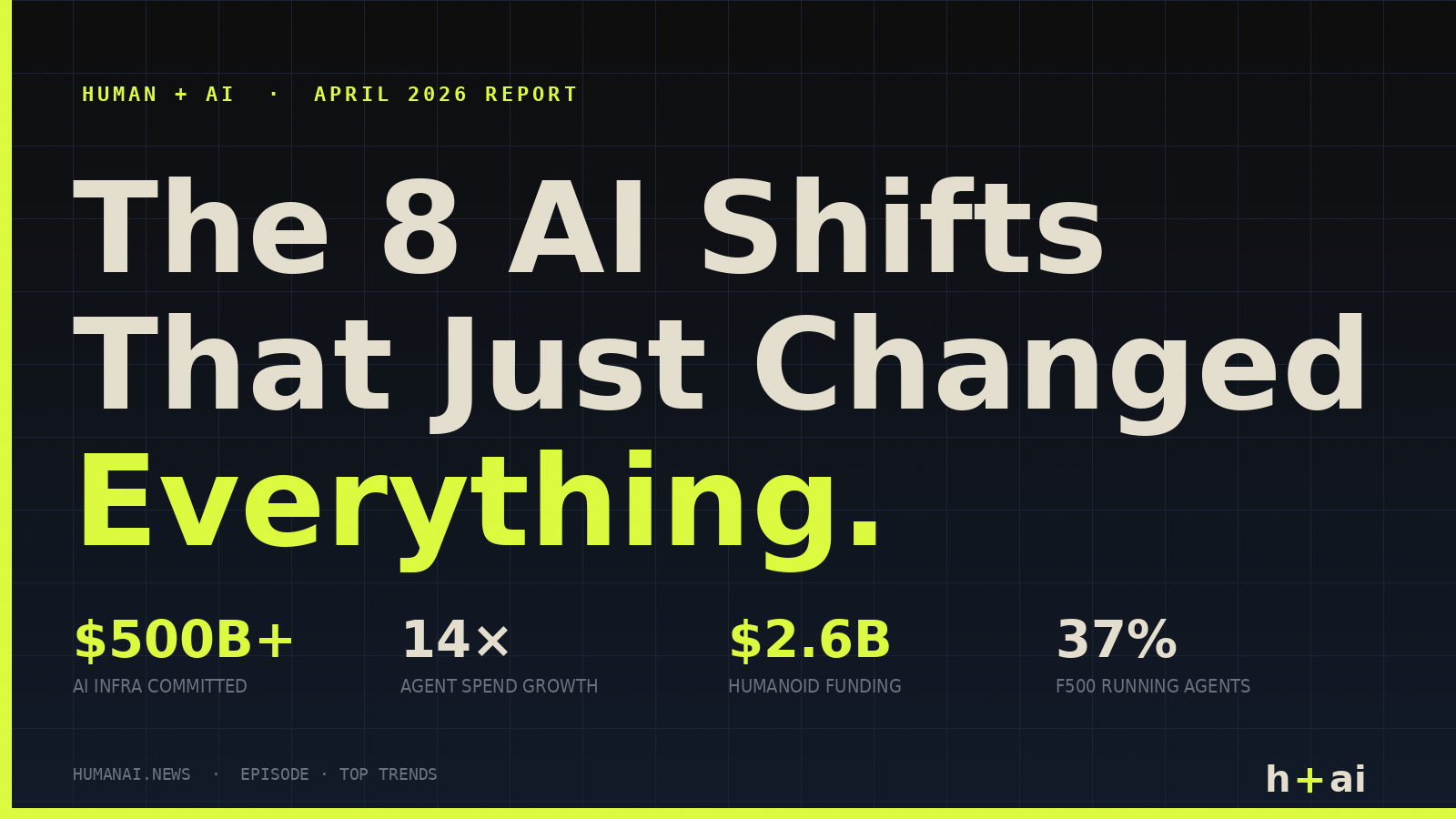
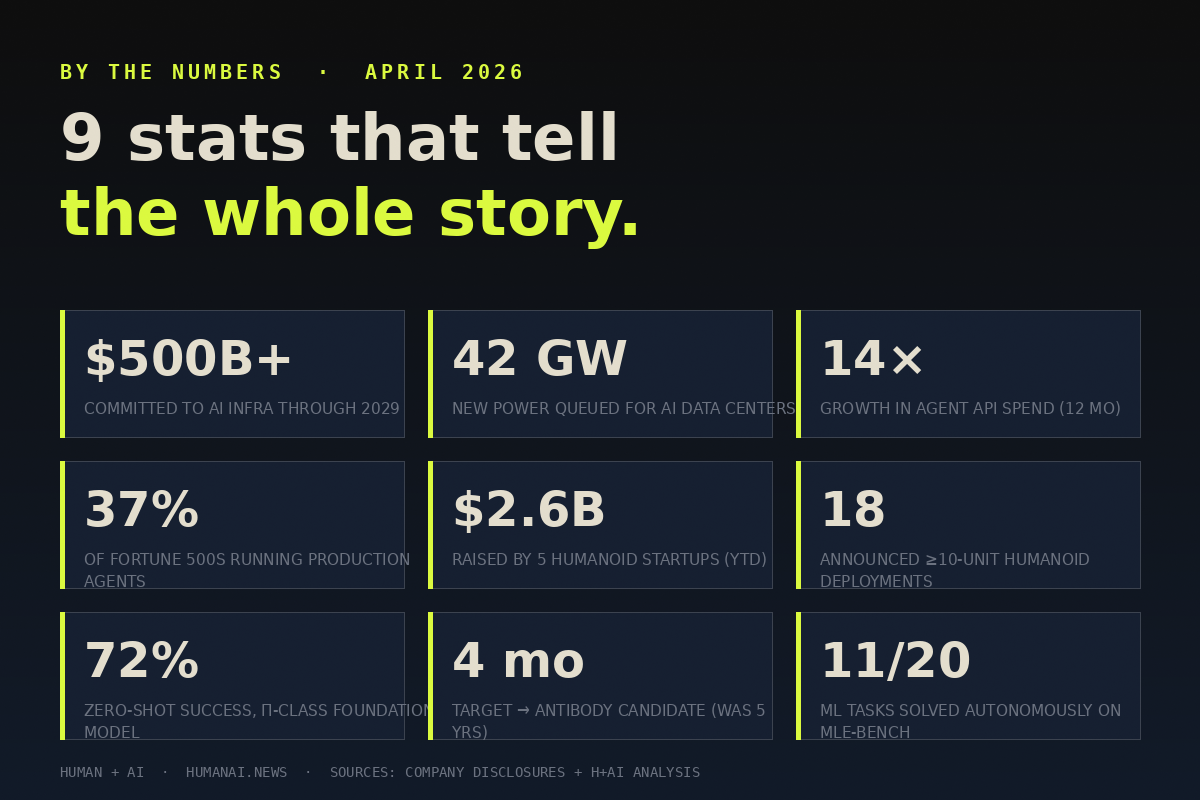
April 2026 is the month AI stopped being a demo reel. Humanoid robots are signing multi-year factory contracts. More than a third of the Fortune 500 is running agents in production. Over half a trillion dollars is being committed to AI infrastructure through 2029. And somewhere in a sandbox, a model just proposed an experiment, ran it, and wrote the paper.
Here are the eight shifts we're tracking this month — what's actually happening, the numbers behind it, and what any small or mid-sized business should do about it in the next 90 days.
01 · Humanoids, for real this time
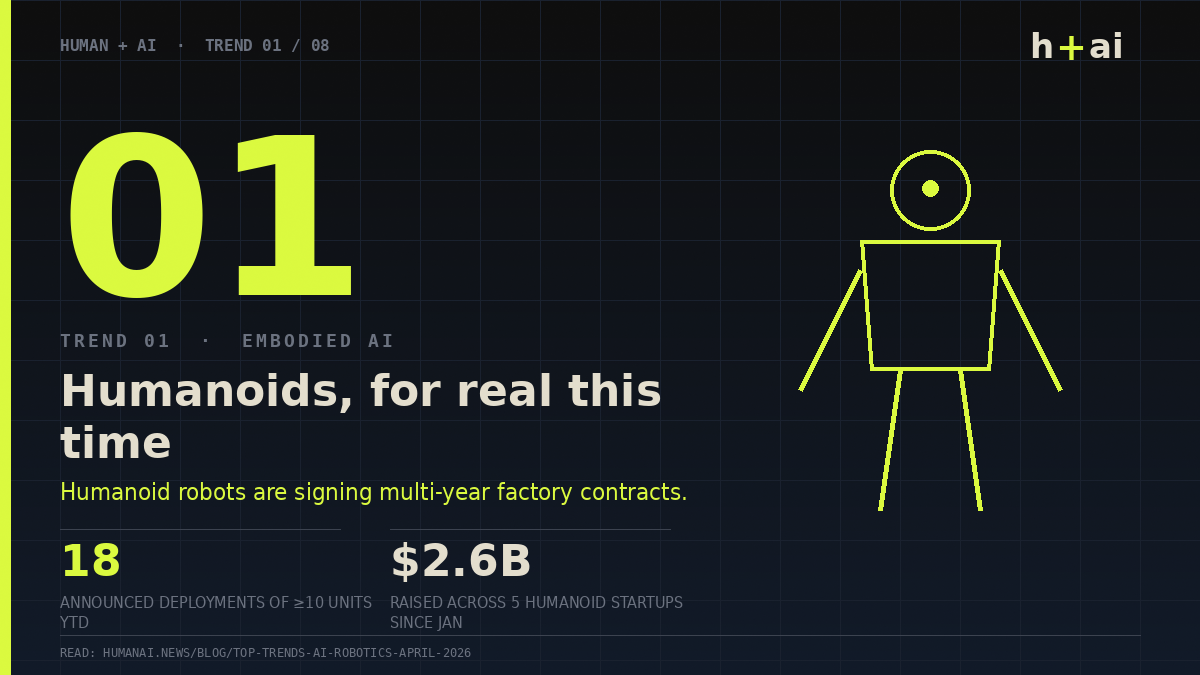
Figure, Apptronik, Agility, and 1X aren't selling demos anymore — they're shipping bipedal workers into auto plants and warehouses on real paper. Eighteen announced deployments of ten or more units so far this year. $2.6B raised across five humanoid startups since January. The common pattern is a teleop-to-policy data flywheel: one unit learns a new task in hours because every other unit in the fleet contributes training data. That's not a science project — that's a business.
What to do this quarter:if your business involves a physical workflow that's currently bottlenecked on human availability — warehousing, light manufacturing, kitting — start tracking which of the humanoid platforms ships in your region and what their per-hour contract rate is. You don't need to deploy yet. You need a number.
02 · Agents that finish the job
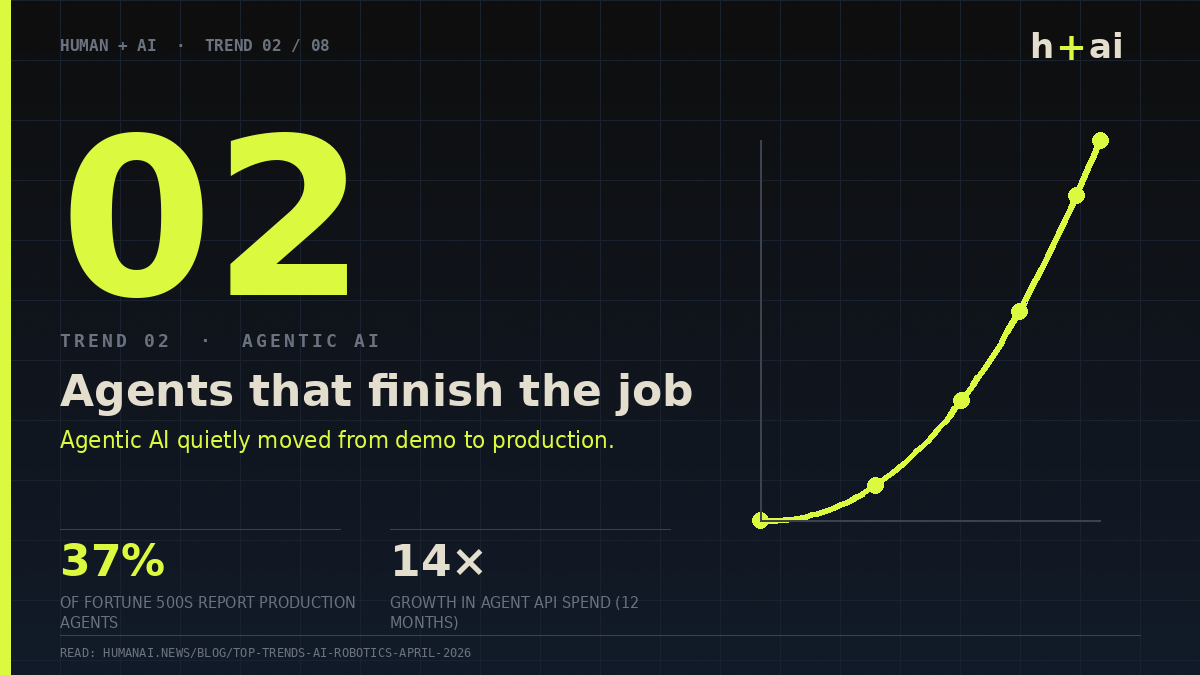
Claude's computer use, OpenAI's Operator, and a dozen vertical agents now run multi-step work — support tickets, recruiting pipelines, accounting close — end-to-end. Thirty-seven percent of the Fortune 500 report at least one agent in production. Agent-tier API spend is up 14× in 12 months. A new job title showed up on LinkedIn this quarter: AI Agent Manager.
What to do this quarter:pick the single most painful repeatable workflow in your business and rebuild it as an agent — not as a chatbot. The “chatbot” framing is why most teams are underusing current models by an order of magnitude. This is exactly the kind of work we build for SMEs.
03 · Physics you can walk inside
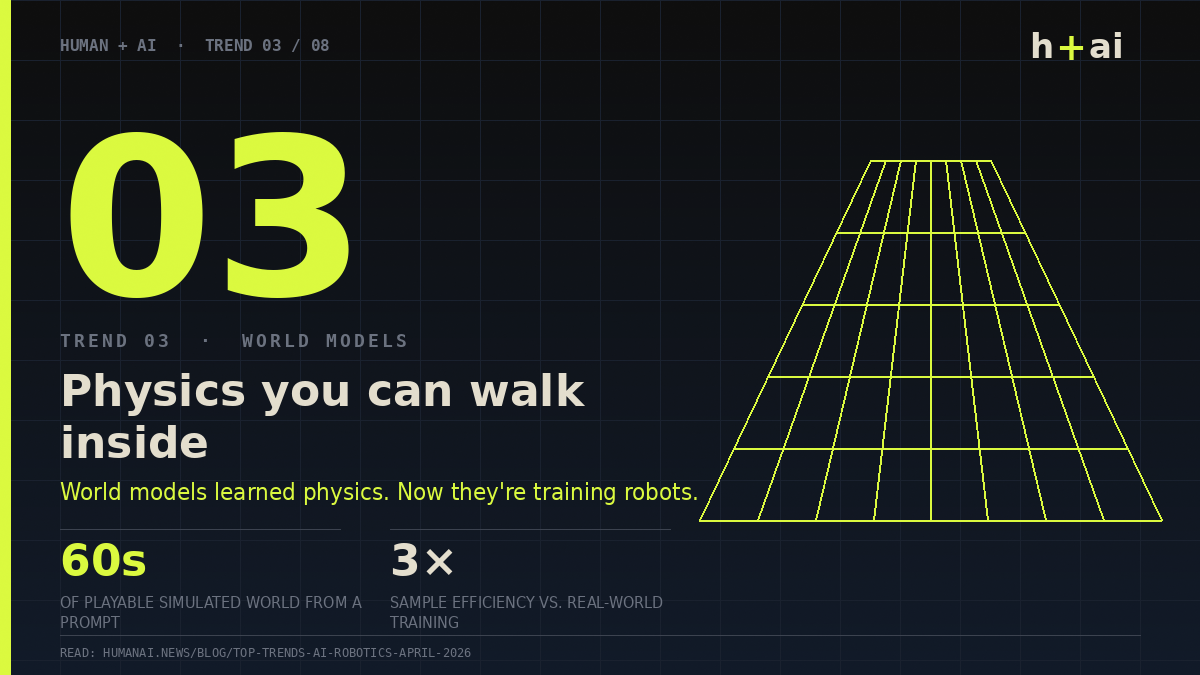
Genie 3-class models don't just generate video — they let an agent act inside a simulated world with consistent gravity and object permanence. Sixty seconds of playable simulated world from a single prompt. Three times the sample efficiency versus real-world robot training. Which means you can now train a self-driving stack, or a picking arm, without crashing a single car or breaking a single workpiece.
Why this matters:world models are the missing piece between “LLM” and “robot that does useful things.” Every robotics company you care about — including the humanoid platforms in Trend 01 — is quietly retooling its training stack around simulated physics.
04 · Small models are the real story
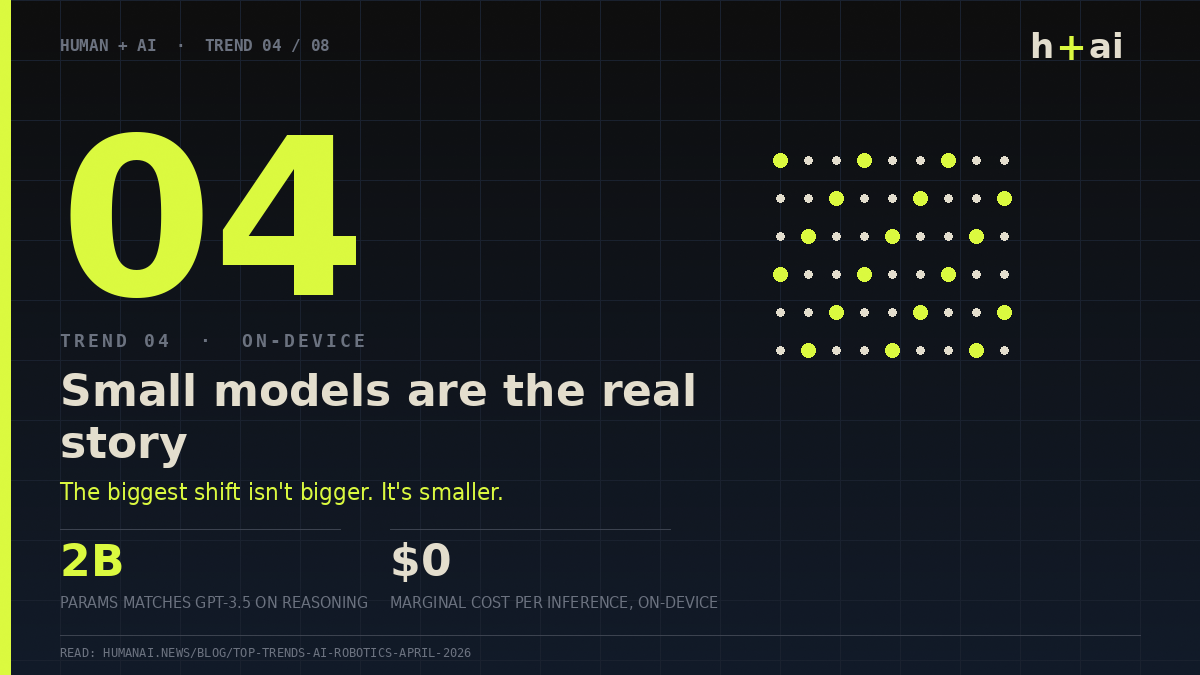
Gemini Nano. Apple Intelligence. Phi-4. Llama 3.2 on a phone. A capable 2B-parameter model now matches GPT-3.5 on reasoning benchmarks and runs privately, on-device, at zero marginal inference cost. The biggest shift isn't bigger. It's smaller. Latency, privacy, and cost problems that blocked an entire class of AI products just collapsed in one release cycle.
What to do this quarter:if your product wraps an LLM API and your margin is the difference between what you charge and what OpenAI charges you, you have a strategic decision to make this quarter. Small on-device models are the pressure you should be planning around, not the one you'll notice next year.
05 · AI co-authors on the horizon
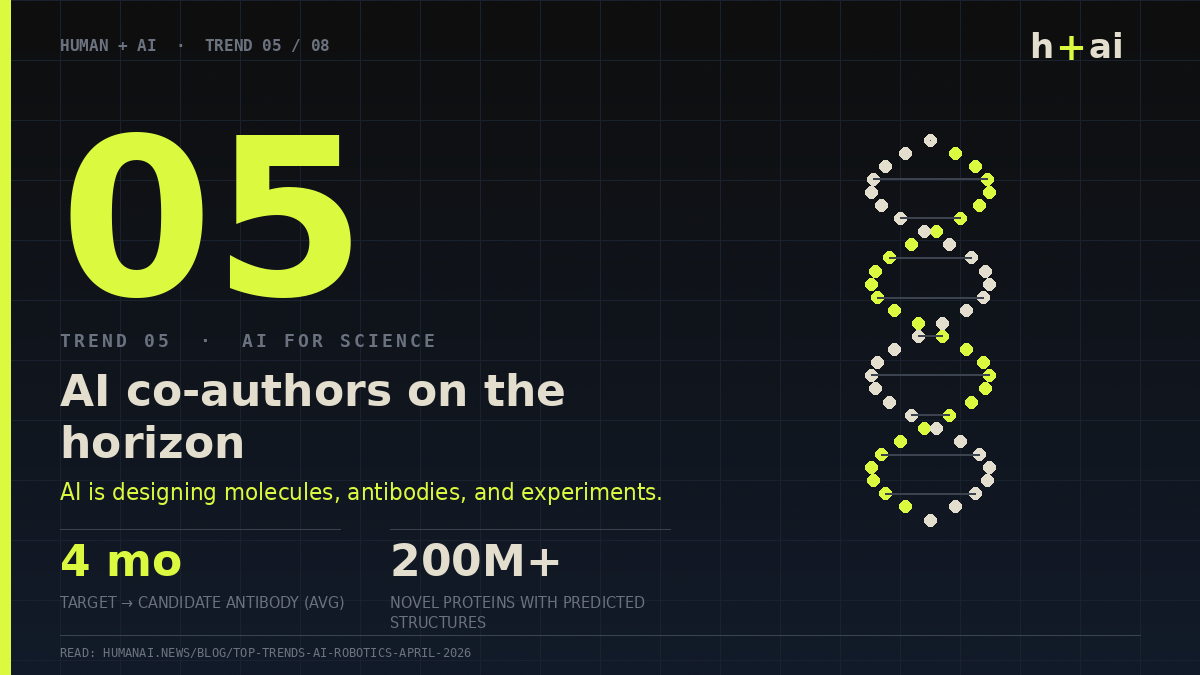
Isomorphic Labs, Profluent, Future House — models now propose candidate proteins and antibodies that wet labs synthesize in days, not years. Four months from target to candidate antibody on average, down from roughly five years. Two hundred million novel proteins with predicted structures. The first Nobel Prize with an AI co-author is closer than most people think.
06 · One brain, many bodies
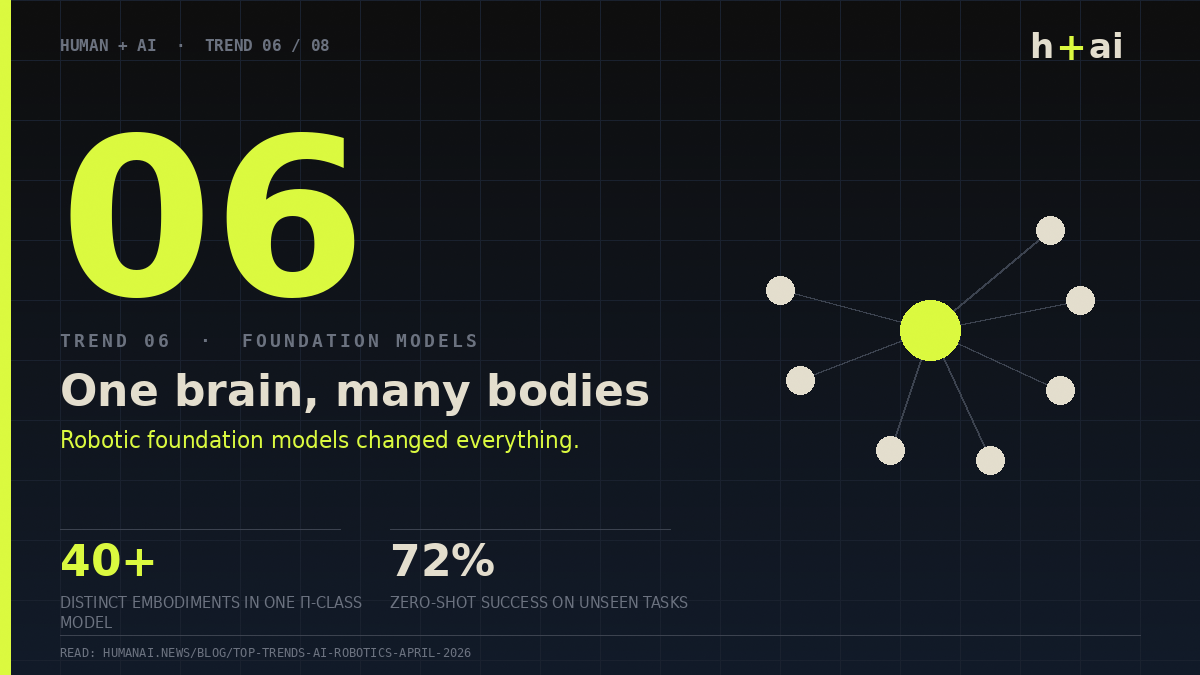
Physical Intelligence's π-series and RT-2 successors train on teleop data from every robot in the fleet. One policy drives arms, grippers, humanoids — and zero-shot transfers to bodies it's never seen. Forty-plus distinct embodiments in one π-class model. Seventy-two percent zero-shot success on unseen tasks. This is the trend your engineer friends won't shut up about, and they're right to be excited — it's the foundation-model moment for robotics.
07 · The biggest build in history
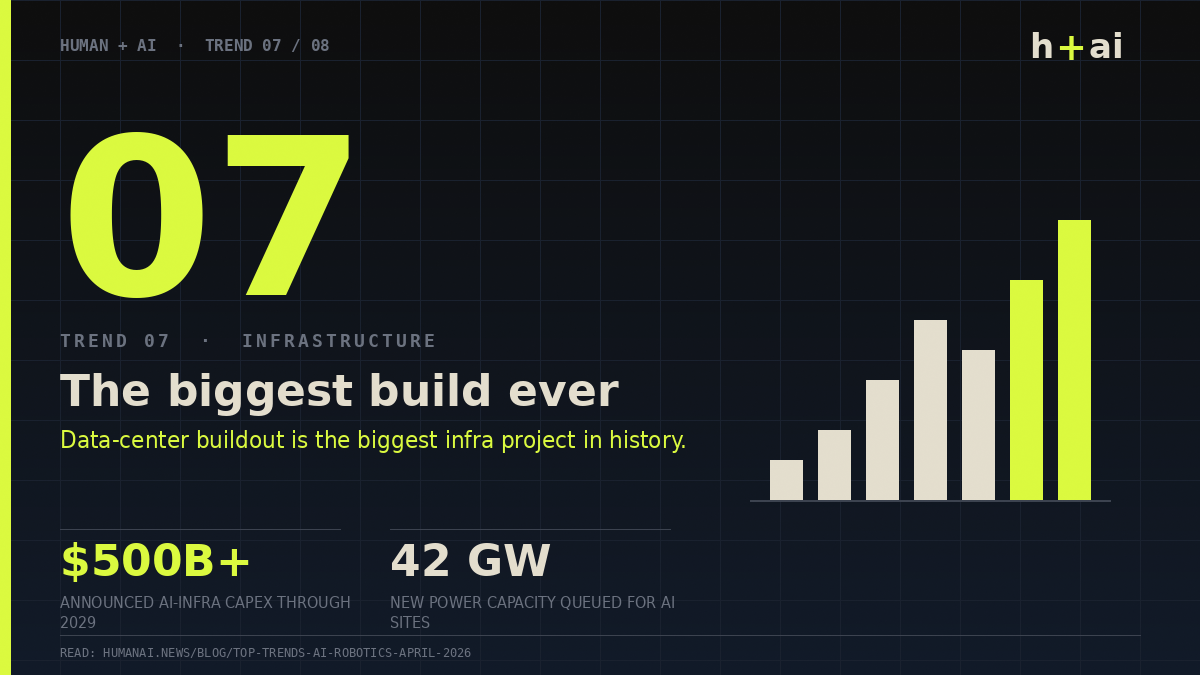
Stargate. Colossus 2. MGX-backed campuses in the UAE. Over half a trillion dollars committed to AI infrastructure through 2029. Forty-two gigawatts of new power capacity queued for AI sites. The sleeper story is power — retired nuclear plants coming back online, gas peakers going up right next to training runs. Any honest conversation about the next five years of AI has to start with the grid.
08 · Models that run their own experiments
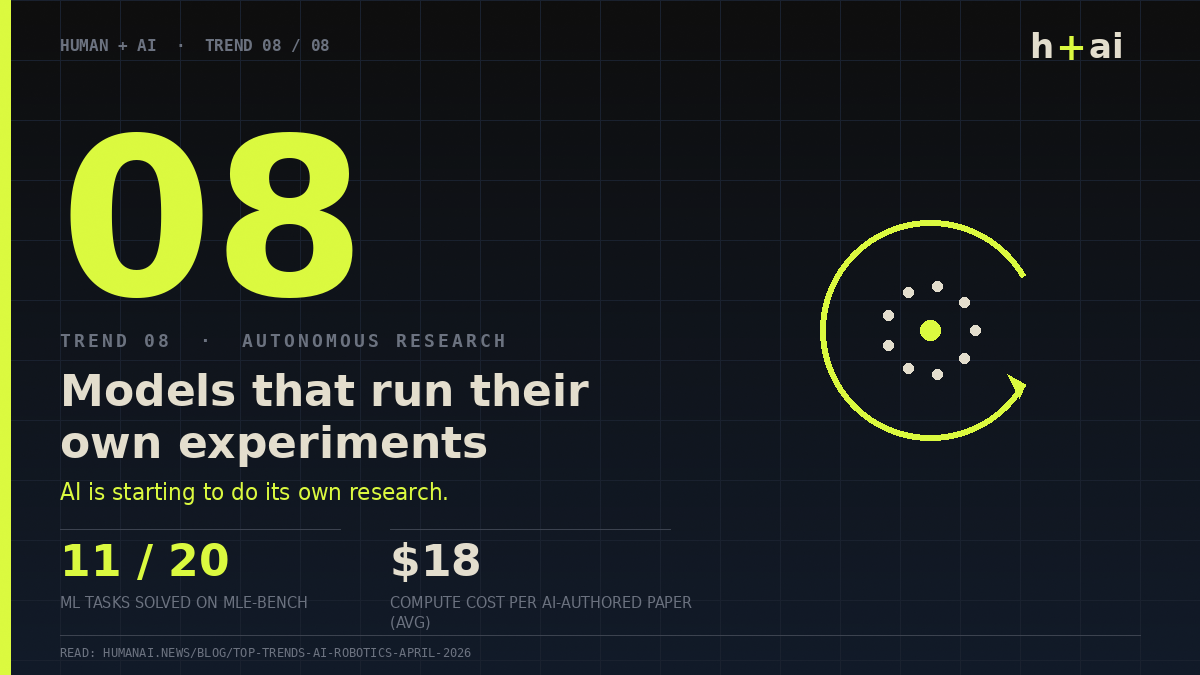
Sakana's AI Scientist. DeepMind's FunSearch. OpenAI's MLE-bench. Models that read papers, propose experiments, run them in a sandbox, and write up results. Eleven out of twenty ML tasks solved autonomously on MLE-bench. Eighteen dollars of compute per AI-authored paper on average. Quietly, this is the shortest path to recursive self-improvement — and the reason alignment folks are paying very close attention in 2026.
What this means if you run a business
Zoom out and the pattern is clear: every one of these eight trends is a hand-off. Work that used to require a human is now being handed — reliably, not theatrically — to a machine. Physical work is handed to humanoids. Knowledge work is handed to agents. Training data is handed to simulated worlds. Inference is handed to the device in your pocket. Even research itself is starting to hand itself to the models.
For a small or mid-sized business, the practical read is blunt. You don't need to be ahead of all eight. You need to pick one — the one closest to where your work actually happens — and rewire a single workflow around it this quarter. Teams that do that compound an advantage over the rest of 2026. Teams that wait for all eight to “settle down” are going to spend 2027 catching up.
That's the bet Human+AI is built on. And it's why the channel exists in the first place: one new shift every week, explained for people who actually have to decide what to do about it.
Want one of these eight shifts running inside your business?
We help SMEs design and ship agentic workflows that actually stick. If there's one painful, repeatable process you want rebuilt around agents, small models, or a world-model-trained robot, that's what we do.
Book a free 15-min AI audit